Compliance infrastructure for every stablecoin issuer
Alksea automates GENIUS Act compliance: transaction monitoring, sanctions screening, SAR filing, and CIP policy generation, so your team doesn't have to build a bank-grade compliance department from scratch. Whether you're issuing your first stablecoin or your fiftieth billion in circulation, it scales with you.
The GENIUS Act turned every stablecoin issuer into a bank-grade regulated entity overnight.
But compliance costs are largely fixed, not proportional to size. Issuers face nearly the same requirements regardless of how much they have in circulation.
Nearly identical compliance requirements
issuers now in scope
Payment stablecoin issuers face new regulatory requirements under the GENIUS Act.
month compliance deadline
After the final rule is published, issuers have limited time to stand up programs.
year recordkeeping
Complete audit trails must be maintained for every suspicious activity and filing.
Understanding the basics
A quick primer for compliance teams new to stablecoins.
What is a stablecoin?
A stablecoin is a digital dollar: a cryptocurrency designed to always be worth $1, backed 1-to-1 by real dollars or Treasury bonds held in reserve.
Companies issue them so people can send digital dollars instantly, 24/7, without a bank in the middle.
What is the GENIUS Act?
The GENIUS Act is the first federal law regulating stablecoins, passed in 2025. It requires any company issuing a payment stablecoin to follow bank-style rules: verifying customer identity, screening for sanctioned wallets, monitoring for suspicious activity, and filing reports, even if the company isn't a bank.
Why does this create a compliance gap?
Compliance costs are largely fixed, not proportional to size. A company with $500 million in circulation faces nearly the same requirements as one with $50 billion, just without the budget or team to match.
That gap is what Alksea is built to close.
How it works
A complete compliance workflow built for the specifics of payment stablecoin issuance.
Monitor
We watch every mint, burn, and transfer on-chain in real time.
Screen
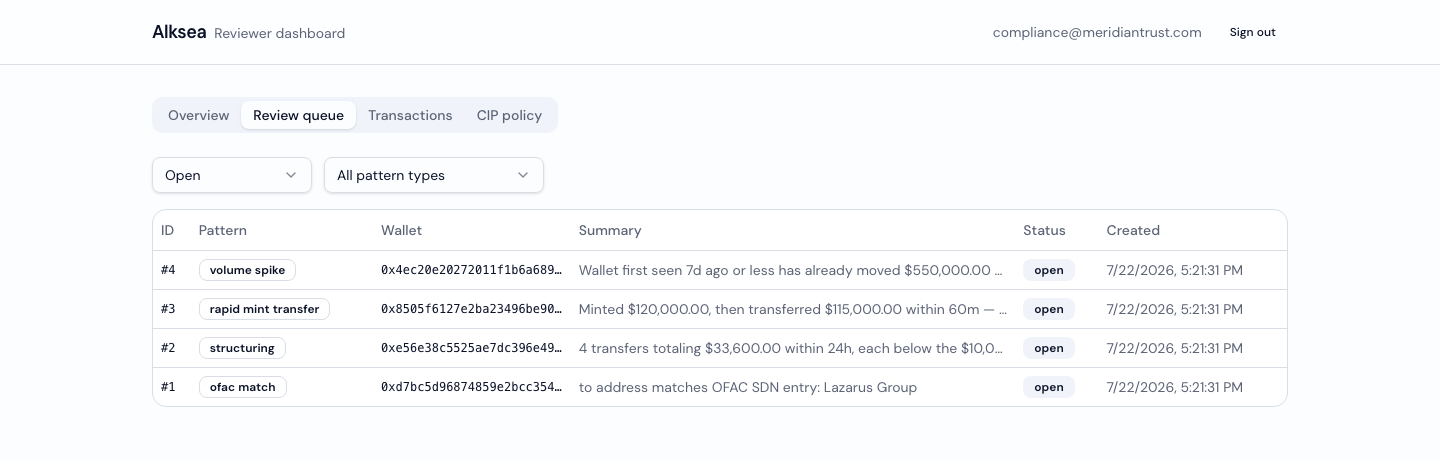
Every wallet is checked against OFAC sanctions lists and recognized patterns like structuring and rapid mint-to-transfer activity.
Draft
When something's flagged, AI drafts a complete SAR narrative from the actual transaction data in seconds, not hours.
File
Your team reviews, approves, and files, with a complete audit trail kept for 5 years.
Monitor
We watch every mint, burn, and transfer on-chain in real time.
Screen
Every wallet is checked against OFAC sanctions lists and recognized patterns like structuring and rapid mint-to-transfer activity.
Draft
When something's flagged, AI drafts a complete SAR narrative from the actual transaction data in seconds, not hours.
File
Your team reviews, approves, and files, with a complete audit trail kept for 5 years.
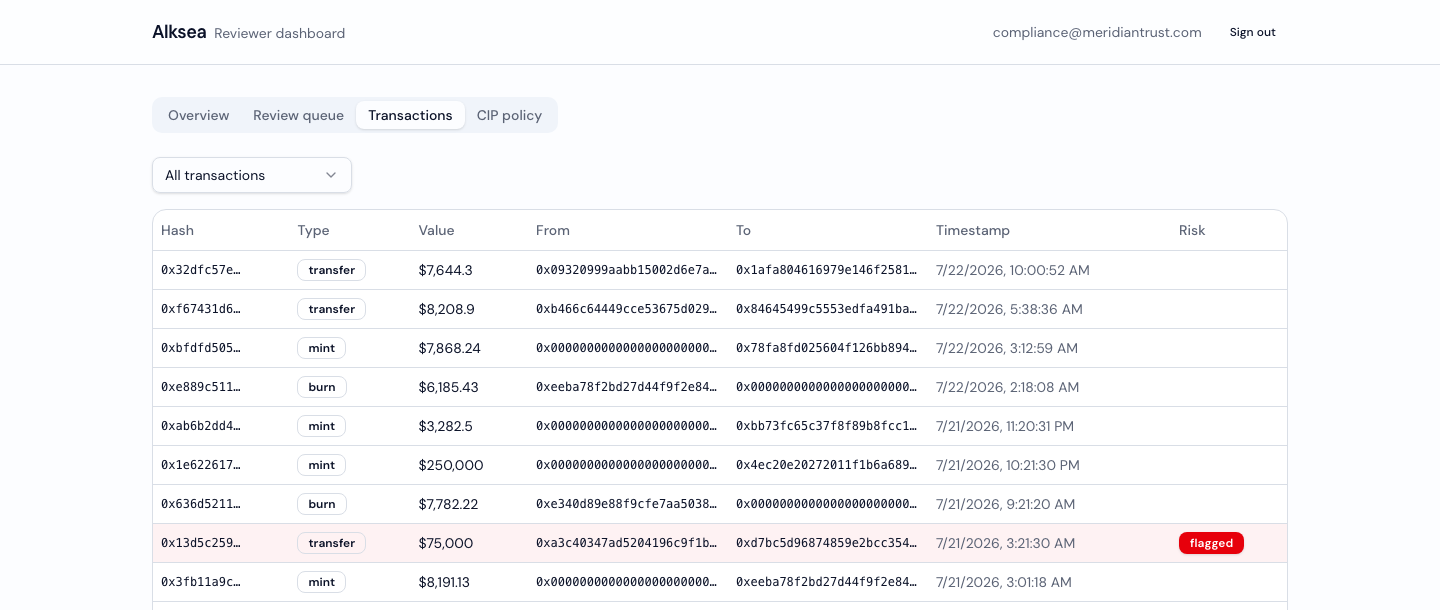
Every transaction, screened and pattern-matched as it happens
Every mint, burn, and transfer is ingested the moment it happens and automatically checked against sanctions lists and recognized risk patterns: structuring, rapid mint-to-transfer activity, and sudden volume spikes from a new wallet. Nobody on your team has to comb through raw chain data in a spreadsheet.
Detection rules you can actually explain
Every flag comes from a documented, adjustable threshold, not an unexplainable model. When your compliance officer has to justify a SAR to a regulator, "here's the exact rule that fired" beats "the algorithm decided."
OFAC sanctions match
Every wallet is checked against the Treasury's OFAC sanctions list before a transaction clears.
Structuring
3 or more transfers totaling over $10,000 from the same wallet within a 24-hour window.
Rapid mint → transfer
$50,000 or more minted and moved out again within 60 minutes.
Volume spike
A wallet less than 7 days old suddenly moving more than $500,000.
Every flagged transaction routes to a review queue where your team decides what happens next. Nothing files itself.
Built for every stablecoin issuer under the GENIUS Act
From a fintech shipping its first stablecoin to an issuer with billions in circulation, the compliance requirements are nearly identical. Alksea scales with you instead of making you outgrow it.
Stablecoin-native issuers
Companies whose core product is a payment stablecoin and need compliance to match their scale.
Fintechs launching their first stablecoin
Teams expanding into stablecoins and building their compliance program from the ground up.
Regional banks and credit unions
Financial institutions entering digital dollars without a dedicated crypto compliance team.
Purpose-built for stablecoin compliance
Enterprise compliance software is built for banks. Generic KYB platforms aren't built for the specific mint/burn/wallet-level requirements of payment stablecoin issuers. Alksea is designed for exactly this.
Issuer-specific workflows
Mint, burn, and transfer monitoring mapped to the actual lifecycle of a payment stablecoin.
Audit-ready by default
Every decision, edit, and filing is logged automatically for 5-year recordkeeping.
Right-sized pricing
A compliance department in a box, without the cost of bank-grade enterprise software.
AI-drafted, human-filed
AI writes the first draft of every SAR narrative and CIP policy document from your actual transaction data. Your team reviews and signs off before anything goes out.
Get early access
Join the design partner program and help shape Alksea for your compliance team.
We're onboarding a small number of design partners first.